


Thomas Hamilton Walker (b.1887 - d.1975)
Thomas Hamilton Walker Jr. was born on February 3rd, 1887 in the quaint town of Armadale in south central Scotland. He was named after his father, but only after a previous son born eight years earlier had also been given the same name, but who had unfortunately died at the early age of two. After this, the family had three more daughters until they finally had another son who was again christened Thomas Hamilton Walker. Against all odds, considering what he subsequently went through, Thomas lived to the ripe old age of 88. In his later years he was also fondly known as “Tammy”.
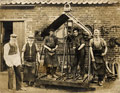 The earliest years of Thomas H. Walker are not well documented, but it is known that early in his working career he followed his Fathers footsteps to the coal mines of south-central Scotland where he worked as a blacksmith. We know this because of a single surviving photograph that was taken when Thomas would have been around 20 years old.
Travel to Canada In 1910, Thomas, his brother John and sister Mary traveled to Canada where they settled in Winnipeg, Manitoba. Not long after arriving in Canada, Thomas resumed his work as a blacksmith.
Tracing Thomas Walker's war record
The record of Thomas Walker's years of service in France and Belgium from 1915 until the end of the war was pieced together using a combination of service records and the war diaries from the various units with which he served. The discovery of a remarkable letter he sent home in 1915 also provides a rare insight into his personal experiences during his first few months on the front. Ref:1
1914 – Outbreak of War
When news that war had broken out in Europe in August of 1914, Thomas immediately volunteered for service at the Winnipeg barracks. A few short weeks later he arrived in Valcartier, Quebec with the 90th Regiment of the Winnipeg Rifles, initially with the 11th Battalion, ‘C’ Company. Ref:2
He signed his Attestation Papers at Valcartier on Sept 23rd, 1914, where he listed his occupation as “blacksmith”. Thomas and his Battalion left Quebec on Oct 1st, 1914 aboard the S.S.Franconia and arrived in England on Oct 14th,1914. Ref:3
1915 – Arrival in France, the Ypres Salient, and a letter home
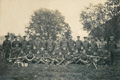 On Jan 31st, 1915, Thomas was transferred to the 8th Battalion, 2nd Brigade,
1st Division (where he remained until February 1916). A few weeks later, in February 1915,
his battalion set sail across the English channel for France.
On Jan 31st, 1915, Thomas was transferred to the 8th Battalion, 2nd Brigade,
1st Division (where he remained until February 1916). A few weeks later, in February 1915,
his battalion set sail across the English channel for France.
During the spring and summer of 1915, Thomas and his battalion were involved in the following battles, which he described in his only surviving letter sent during the war.
Thomas Walker's letter from the front.
- Neuve-Chapelle (in reserves), Mar 1915
- 2nd Battle of Ypres, 21-25 April, 1915 || Battlefield panorama, 17 April 1915
- Festubert May 15-25, 1915
In August 1915, Thomas Walker was promoted to “unpaid Lance Corporal”.
1916 – The Ypres Salient and the Somme
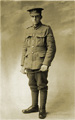 In late 1915, the decision was made to create dedicated Machine Gun Companies
attached to each Brigade and sharing the same Brigade number. In February 1916,
Thomas Walker was promoted to Sergeant and at the same time transferred to the 2nd Brigade,
Canadian Machine Gun Company (C.M.G.C), which he was with until February 1918. Ref:4
In late 1915, the decision was made to create dedicated Machine Gun Companies
attached to each Brigade and sharing the same Brigade number. In February 1916,
Thomas Walker was promoted to Sergeant and at the same time transferred to the 2nd Brigade,
Canadian Machine Gun Company (C.M.G.C), which he was with until February 1918. Ref:4
The 2nd Brigade, C.M.G.C. spent the winter of 1915-16 in the area around the Ypres Salient. Once summer arrived, the Brigade was sent into the front lines where it was involved in the following battles:
- Mount Sorrel June 2-13, 1916 (supported attack with indirect fire)
- The Somme (Thiepval) Sept 2nd –28th (Ancre Heights) Oct 1st -Nov 11th, 1916 (The 2nd Bde played a supporting role with the C.M.G.C. offering indirect fire.)
On July 8th, 1916, Thomas was promoted to Company Sergeant Major, Warrant Officer 2nd Class, the highest rank for a non-commissioned officer.
1917 – Vimy Ridge and Passchendaele
During 1917, the 2nd Brigade, C.M.G.C. was involved in the following battles:
- Vimy Ridge: Apr 9-12, 1917
- Arleux: Apr 28-29, 1917
- Hill 70 - Lens: Aug, Sept 15-16, 1917
- Passchendaele, 3rd Battle of Ypres: Oct.26th-Nov.10th, 1917
Three months after Vimy Ridge, in July, 1917, Thomas was attached to the British 1st Army School where he spent three weeks in training before returning to his unit, the 2nd Brigade, C.M.G.C. in August 1917, just in time for the battle of Hill 70.
In February 1918, the Canadian Machine Gun Corp was reorganized into their own battalions and Thomas was transferred to the 1st Battalion, Canadian Machine Gun Corp (No.1 Company, “A” Battery) where he spent the remainder of the war. Ref:5
1918 – Heroism and Canada’s Finest Hour
The 1st Battalion, Cdn Machine Gun Corp fought in the following battles:
- Amiens, Aug 8-11th, 1918
- Arras, Aug 26th – Sep 3rd,1918
- Drocourt - Queant Line, Sept 2-3rd, 1918: where Thomas won the D.C.M.
- Hindenburg Line, Sept 12 – Oct 9th, 1918
- Canal du Nord, Cambrai, Sept 27th – Oct 11th, 1918
After the war
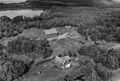 Thomas returned to Canada in 1919 and soon afterwards moved to Pilot Mound, Manitoba where he began farming with his sisters Mary, Elizabeth and brother-in-law, Thomas Pow Watson. John Walker joined them out at the farm in 1925 where he died in 1937. Thomas moved to a retirement home in Winnipeg in the late 1960's. He died there in 1975 at the age of 88.
 Copyright © 1996-2025 TwoCreek :: All rights reserved