


Passchendaele - the 3rd Battle of Ypres, Nov 1917
The 3rd Battle of Ypres began in July 1917 with the ambitious intention of breaking through the German lines in the Ypres Salient near Passchendaele and then advancing to the coast to capture the German occupied Belgian channel ports. Three months later, the British and Australians had advanced no more than a few thousand yards at a cost of over 100,000 casualties.
The soldiers endured conditions of unimaginable desolation. Continuous artillary bombardments, bottomless quagmires of mud and heavy rains conspired to make this battlefield the worst on the Western Front. Against the objections of the Canadian Commander Arthur Currie, the Canadian Corp was ordered into the Passchendaele sector to relieve the British in October 1917.
The 2nd C.M.G.C., which was attached to the 2nd Inf Brigade, moved into the Passchendaele sector in early November 1917. On November 10th, under relentless artillery fire, the 2nd Brigade reached their objectives on Passchendaele Ridge.
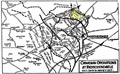 One of the objectives the brigade traveled through was the town of Gravenstafel, which, if Thomas Walker was present during this battle, he had already seen two years earlier during the 2nd Battle of Ypres. Considering the conditions at the time, it is unlikely any of it was recognizable.
By the time the battle for Passchendaele was over, and for the 10 days between Nov 2nd and 12th, the 2nd Brigade C.M.G.C. lost 170 men (C.S.Grafton p.99). As a whole, the Canadian Corp lost a total of 16,000 men (as Currie predicted they would) in the two weeks they fought for, and captured, the strategically insignificant town of Passchendaele.
 Copyright © 1996-2025 TwoCreek :: All rights reserved