


Reference:1 - Certainty of military engagements for Thomas Walker
With the exception of 1915 where his letter confirmed his involvement in several key battles, and for the latter part of 1918 where the exceptional war diaries and his recorded involvement in the Battle of the Drocourt- Queant Line indicated clearly Thomas Walker's active service in the critical stages of the last 100 days of the War, the remaining years 1916 and 1917 can only be indirectly inferred.
During 1916 and 1917, it hasn’t been, and can never be, absolutely confirmed whether Thomas Walker was present during the listed battles his Company was involved in. But since the periods when he was on leave are known, and that he was never known to have been hospitalized, it is assumed that in all likelihood, he was present in some capacity with the 2nd Bde C.M.G.C. during the battles listed for 1916 and 1917, and with the 1st Battalion, C.M.G.C. during all of 1918.
Timeline of units that Thomas Hamilton Walker served with during WW1:
- Sep 1914 - Feb 1916: 8th Battalion, 2nd Brigade, 1st Division
- Mar 1916 - Feb 1918: 2nd Brigade, Canadian Machine Gun Corp C.M.G.C.
- Mar 1918 - Feb 1919: 1st Battalion, (No.1 Company, “A” Battery) Canadian Machine Gun Corp
Recorded leave to England
- May 11th - 20th, 1916
- Dec 30th, 1916 - Jan 13th, 1917
- Dec 29th, 1917 - Jan 19th, 1918
- Dec 28th, 1918 - Jan 18th, 1919
Reference:2 - 90th Regiment of the Winnipeg Rifles
The 90th Regiment of the Winnipeg Rifles were known as the “Little Black Devils”. They came into being in November 1883 and by tradition, the Infantry of the line usually wore red coats, while Rifle units wore dark green, almost black, coats.
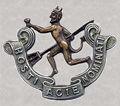 After the Battle of Fish Creek during the Northwest Rebellion of 1885, a captured prisoner, awed by the cool, steady advance of the sharpshooting Rifle said afterwards, "The red coats we know, but who are those little black devils?". Hence their Latin motto: “Hosti Acie Nominati”, “named by the enemy in battle”.
During the First World War the 90th Regiment – Winnipeg Rifles contributed to the 8th Battalion, CEF on its formation in September 1914. The 8th Battalion served in France and Flanders with the 2nd Infantry Brigade, 1st Canadian Division from 13 February 1915 until the Armistice.
Reference:3 - S.S.Franconia
The S.S.Franconia was a cruise ship requisitioned from the Cunard Lines during the war to serve as a troop ship. It was later torpedoed and sunk by a German submarine off the coast of Malta in 1916.
Reference:4 - Naming of Canadian Machine Gun Companies
Formation of Brigade Machine Gun Companies, an important step in establishing Machine Gunnery as a separate arm with tactics of its own and intermediate between those of infantry and artillery, was authorized on October 29th, 1915. Canadian Machine Gun Companies remained associated with their original units and took their names from the Brigades to which they were attached. (C.S.Grafton, 1938, p.37, “A History of the Canadian Machine Gun Corps”)
Note: The “2nd Brigade Canadian Machine Gun Company” was also called the “2nd Canadian Machine Gun Company” in the War Diaries.
Reference:5 - Formation of the 1st Battalion, Canadian Machine Gun Corp
The reorganization of the Machine Gun Companies into battalions took place in March 1918. The 1st Battalion, Canadian Machine Gun Corp (CMGC), was created at Cambrai in March 1918 by regimentation of M.G. companies formed earlier in Nov 1915.
It was composed of the 1st, 2nd, 3rd and 13th Canadian Machine Gun Companies. The 2nd and 3rd Companies were united to form No.1 Company (1st Battalion) under the command of Capt. E.R. Morris. (C.S. Grafton p.106)
The 1st Battalion, C.M.G.C. was commanded by Lieutenant-colonel S.W. Watson. The 1st Battalion, C.M.G.C. was disbanded by General Order 209 of 15 November 1920. Its colours were deposited in St James Cathedral, Toronto.
 Copyright © 1996-2025 TwoCreek :: All rights reserved