Beaufort Sea - Dome Seismic Survey :: August 1981

Home |
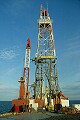
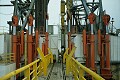
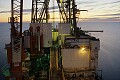
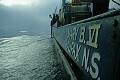
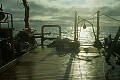
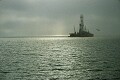
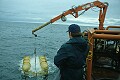
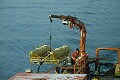
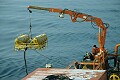
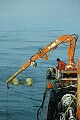
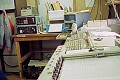
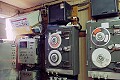
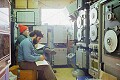
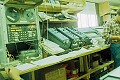
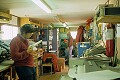
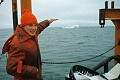
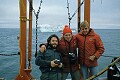
The beginning of a two week journey to the Arctic, <br />flying over southern Alberta farmland... and four hours later, the land <br />of a million lakes appears... that merge seamlessly into <br />the Arctic ocean... the Dome Petroleum 737... repair work on a large Sikorsky helicopter... crew change helicopter... flying in a Sikorsky S-76?<br />on route to the Explorer III... loose ice floating in the ocean... the Explorer III drillship... this was where I was to wait for the <br />seismic boat to pick me up... and for the few hours I was onboard, <br />I had the full run of the ship... the ever-present Supply boat, <br />never far from the drillship... the Canmar Supplier VII, with drill pipe <br />stacked on the drillship deck... there is nothing small on an offshore <br />drillship of this size... hydraulic stabilization jacks... the drill floor. When I arrived the crew <br />had just replaced drill bits... and by the time I left nine hours later, they <br />had tripped in over 2 miles of pipe... and had started drilling again... the pipe stand... the travelling block... drill collars... decompression chamber for divers... walkway below deck... the radio operator, cleaning up after <br />the copy machine leaked ink... rig workers off shift, playing a very <br />early game of video golf... landing on the back deck... workers moving between <br />vessels with the sling... Explorer III drillship at dusk... Canmar Explorer III, Beaufort Sea, August 1981... the midnight sun... the midnight sun... my first glimpse of the seismic boat I would <br />spend the next two weeks on... affectionatly known as the "Mary 'B' Six",<br />out of Halifax, Nova Scotia... the skipper and first mate... the aft deck. The Mary 'B' was a supply boat modified <br />for shallow seismic surveys in the Arctic... aft deck, looking towards the bridge. The trailer on the <br />right is where the survey equipment is housed... survey equipment stored on deck... V-Fin sparker, shallow seabed profiler. It could penetrate <br />about 50ft into the seabed and produce very high <br />resolution images of local stratigraphy... Damien... the V-Fin profiler discharged an electronic pulse into the water from trailing <br />electrodes that created small bubbles, which upon their immediate <br />collapse, generated a very high frequency pulse... deploying the Huntec Boomer, it used a sealed mechanical platter that was pulled <br />apart to create a vacuum, then allowed to collapse back, creating a shock <br />wave that could penetrate about 60-80 ft into the seabed... the equipment was towed about <br />100 ft or so behind the ship... deploying the cable... Canmar drillship, Beaufort Sea, August 1981... docked alongside the Explorer III, this gives some <br />indication of the size of the drill ship compared <br />to the supply boat we were on... the Canmar Explorer III, August 1981... the Beaufort Sea, 1981... the Canmar equipment yard at Tuktoyaktuk <br />Harbour where we returned for supplies... the Mary B in Tuk harbour, moored next to a Canmar Supply <br />boat on the right, and the Canmar Teal on the left... once freed from the confines of the dock, we anchored <br />out in the harbour, which meant relying on the <br />aluminum dorry to get to shore... the DEW line radar station at Tuk... the "mess"... the Mary B engine room... heading out to sea again <br />to a survey site... the mini-sleeve exploder... the mini-sleeve used a complicated but ingenious system <br />to generate acoustic pulses without creating bubbles <br />which could cause ringing in the signal... a mixture of propane and oxygen was injected into the rubber cylinders, and then <br />they were all ignited simultaneously. The rubber sleeves expanded rapidly <br />creating the pulse, and then the exhaust was vented back to the surface... preparing the mini-sleeve for deployment... the mini-sleeve provides the acoustic <br />source the 24 trace recording cable... which extended about 400m <br />behind the ship... the mini-sleeve back on deck being repaired, <br />under a "Cape Breton cottage"... Rusty and Damien... the repaired mini-sleeve exploder... preparing to deploy the mini-sleeve <br />again on a very calm morning... lifting off the cradle... over the side... trailing the umbilical carrying <br />electical and gas lines... underway, in uncommonly good weather... the navigation system, which relied on shore base transmitters, <br />and used early HP computers and pen plotter <br />to record real-time positioning... the DFS IV multi-channel recorder... making observer notes... the Side Scan Sonar recorder and plotter... the operations room... Dwight, who was "red tagged", like equipment similarly tagged <br />which was deemed defective, and could be sent home early... ice berg... the boat and crew were often asked to do "drift tests" near ice bergs, to <br />help determine whether they posed a hazard for the drill ships... crew on the aft deck... crew photo, Ian Watson 2nd from left... ice berg close to the ship... propane tanks, with frost... the ships mess and galley... Dwight in cabin... surrounded by late summer ice... on a drift test, in support of <br />one of the drill ships... the Mary B, lodged in ice... leaving the ship after two weeks aboard. <br />Carried over to the drillship by a sling... the Mary B "Six", and one of the first times I actually <br />saw her from a distance in daylight... the Mary B "Six" steaming off, Sept 1981... the helicopter that would <br />carry me back to Tuk... and nearly home, <br />after a memorable experience.