


John Walker (b.1873 - d.1937)
Famous Scottish Footballer
Thomas’s brother John Walker was born on Aug 24th, 1873 in Shotts, Scotland. Although much of John's early life is unknown, it can be assumed he spent many hours playing football, since it wasn't long before he was recognized as a superior athlete in the game. In his early twenties he rose to fame as a professional football player and during his career, he played for the following teams: Heart of Midlothian 1893-1897, Liverpool 1898-1902, Rangers 1902-04 and Greenock Morton 1904-05.
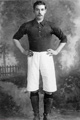 He also held the following honours: He played for Scotland vs. Ireland in 1895, 1898, 1904 and for Scotland vs. Wales in 1897, 1904. He also played five times for the Scottish League team.
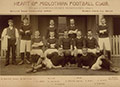 During the 1894-95 season, Hearts won their first eleven games which stands as a club record. The Championship title was all but secured on 16th February 1895 in the fourth last game when Celtic "were destroyed at Tynecastle by the razor sharp, John Walker, who scored twice in a 4-0 win". Hearts were Champions again in 1896-97 season with midfielder John Walker as team captain.
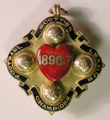
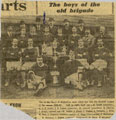 In addition to the Scottish League Championship medals won in 1895 and 1897, John Walker won a Scottish Cup-winners' medal with Hearts in 1896. The following year the team fell on hard times with injuries to key players. This led to strained finances and John Walker was sold to Liverpool for £350.
In 1900 he was at his goalscoring peak with ten goals which included a spell of five in five consecutive games. They earned Liverpool five vital points. He was a player who could score crucial goals, and he underlined that talent during 1900-01 when Liverpool needed one point to win the League. John Walker's goal in the first half against West Brom meant that Liverpool were Football League champions. In total he played 121 games for Liverpool in the Football League and scored 30 goals. In addition he played 12 games in the F.A. Cup and scored once.
In 1902-03, he returned to Scotland and helped Rangers to win the Scottish Cup against his old club, Hearts. During this season with Rangers he played 17 games and scored 7 goals in the Scottish League and five games and three goals in the Scottish Cup. With the Rangers, he was also a Scottish Cup winner in 1903 and finalist in 1904. In 1903-04 he played 21 games and scored 11 goals in the Scottish League, and five games and five goals in the Scottish Cup. He only played a few games for Morton before a knee injury ended his career in 1905. (Thanks to Colin Jose of The Soccer Hall of Fame in Ontario for this information).
Football Awards
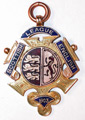
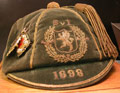
In 1910 John Walker emigrated to Canada and settled in Winnipeg, Manitoba where he began work with the Manitoba Government Telephones.
War history
John had been eager to join the war effort, but unfortunately his knee injury had resulted in a case of "drop-foot" and a wasted calf muscle which made it difficult to enlist. However, he was so determined to get into the army that when it came time to join up (at least according to family lore), he taped putty to his leg to make them look the same. It is unlikely this would have been overlooked, but John was eventually accepted in March 1916, and because of his experience with Manitoba Telephones, he was assigned to the Signal Corp of the Canadian Engineers. On his attestation records he apparently reported his birth date as 1875 instead of 1873, possibly to make himself appear two years younger.
However, in contrast to his brother Thomas, not much is known about his war service. What is known is that he arrived in England in May 1916 and served two years with the Signal Corp of the Canadian Engineers, 5th Reserve Division. In early October 1918, he was sent to France with the 1st Tramways Company which was involved in the effort to build and repair railway lines and bridges necessary to resupply the rapidly advancing troops on the front lines during the last 100 days of the war.
Interestingly, the 1st Tramways Company was assigned to rebuild railway lines through the very area where his brother Thomas and his Machine Gun Battalion had past through literally days before. They effectively followed on the heels of the Canadian Corp from the Arras, Cagnicourt, Cambrai area in early October, all the way north towards Mons by November 1918.
John remained in France until January 1919 when he was sent back to England. In April of that same year he sailed back to Canada and returned to Winnipeg where he resumed his work with Manitoba Telephones as an engineer. In 1925 he moved to Pilot Mound, Manitoba where he took up farming with his brother Thomas and his two sisters Mary and Elizabeth.
He became an avid curler and was known to have skipped the 'Scots' rink in many a memorable 'Spiel'. He died in 1937 as a result of a wood-cutting accident, when a pully-belt slipped off and struck him.
 Copyright © 1996-2025 TwoCreek :: All rights reserved